
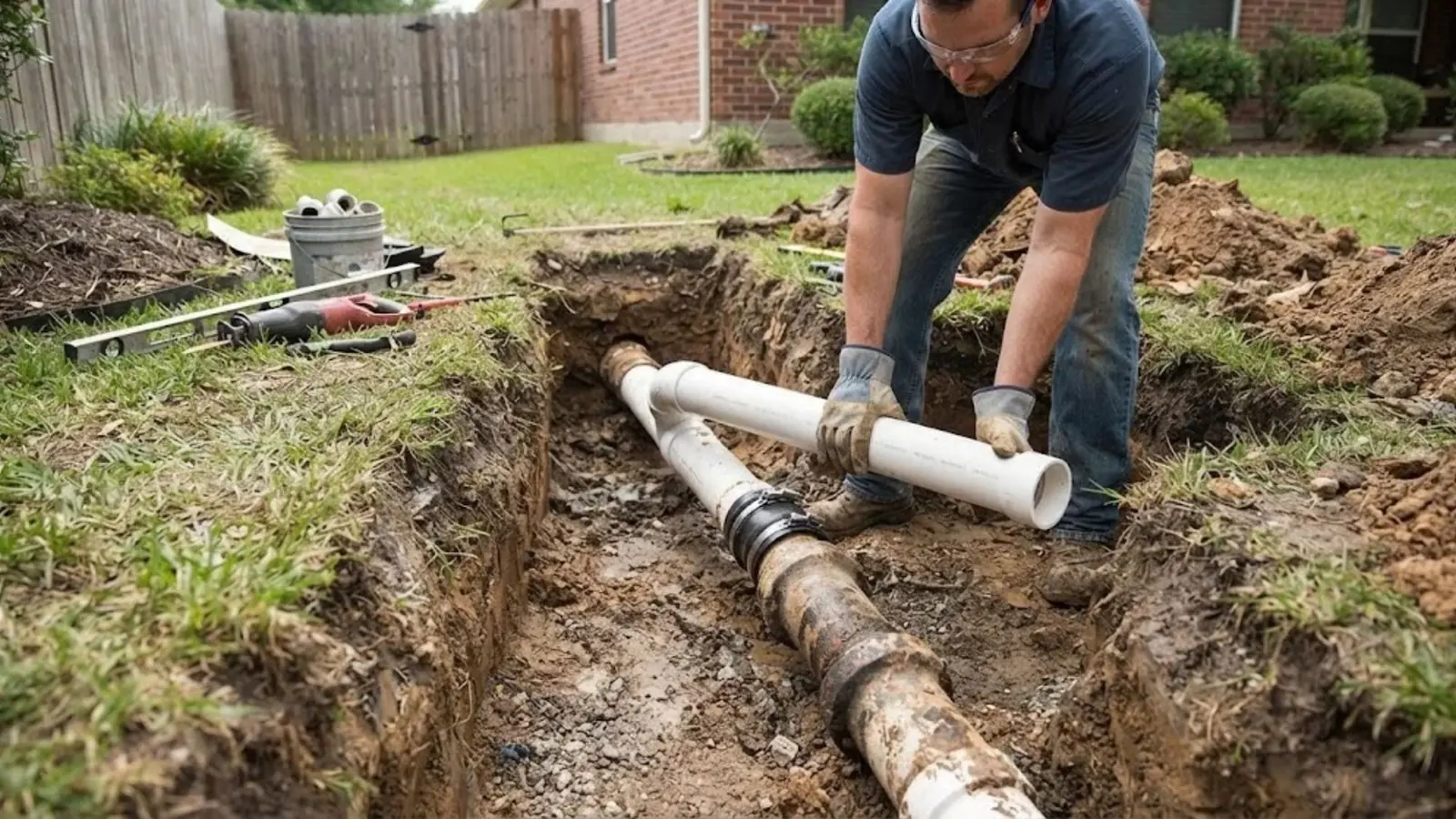
For much of the twentieth century, cast iron was the standard material for drain, waste and sewer lines inside houses and under slabs. It is heavy, quiet and strong, and it can serve for fifty years or more. Eventually the inside of the pipe rusts, scale builds up and the metal thins until it cracks or leaks.
If your home has cast iron drains, you do not need to panic. Many lines work for decades after the first signs of age. You do need to know what failure looks like, what your options are and which jobs belong to a licensed plumber. Cast iron is heavy, and cutting it wrong can injure a person or damage the structure.
Signs a cast iron line is failing
Slow drains that clog again soon after clearing, a rotten egg smell around the drains, damp spots on a floor or crawlspace, and rust stains on the outside of an exposed pipe all point to trouble. A camera inspection shows rough, flaking walls, and a visible crack or a split at a joint means it is past patching.
Tree roots find old joints and cracks first. A line that is repeatedly cabled and keeps stopping up at the same spot may be broken or offset there. Our sewer inspection page explains what the camera shows.
Option 1: spot repair with a clamp or coupling
A single cracked or leaking joint can sometimes be fixed with a stainless steel no-hub coupling that clamps a repair section into place. The plumber cuts out the bad piece, connects a plastic pipe section to the iron ends with rubber sleeves and band clamps, and supports the new run properly. The method is fast and cheap, but it handles only a short section.
It works best when the rest of the line is sound. If the camera shows many rough or thin sections, spot repairs buy time rather than solving the problem.
Option 2: replace the section
For a longer damaged run, the plumber cuts out the iron and installs new ABS or PVC pipe, as the city's plumbing code and inspector allow. Under a slab this means breaking and patching concrete. Inside a crawlspace or a wall, it means access and some drywall repair.
Replacement gives a clean pipe with a smooth interior, which helps prevent repeat clogs. It costs more up front than a clamp, but it ends the problem for that run.
| Option | Best for | Main tradeoff |
|---|---|---|
| Clamp or coupling repair | One cracked joint in a sound line | Covers only a short section |
| Section replacement | A longer damaged run | Needs access, may mean breaking concrete |
| Cured-in-place lining | Hard to reach lines under slabs or driveways | Slightly smaller diameter, needs a cleaned pipe |
| Full line replacement | Widespread corrosion along the whole line | Highest cost and most disruption |
Stuck on this job?
Call and tell us about your plumbing issue.
Option 3: line the pipe
Cured-in-place lining pushes a resin-soaked sleeve through the old pipe and cures it into a new pipe inside the old one. Because it needs little digging, it is useful where the pipe sits under a slab, a driveway or landscaping. The tradeoffs are a slightly smaller inner diameter and the need for the old pipe to be cleaned and reasonably intact, so it does not suit every line.
Which option fits which situation
The right choice depends on the camera findings, the pipe location and your plans for the house. Your plumber should show you the footage, mark where the problem sits and explain why they recommend one option. Ask whether permits apply, since repairs to the sewer usually do. See our sewer line repair page for how a visit works.
Questions to ask before you approve a repair
Ask to see the camera footage and where along the line each problem sits. Ask which sections are cast iron and which are newer plastic, and whether the failure is isolated or general. Ask what the permit covers and who handles inspection. Ask how the plumber will protect the floor and the surrounding area if concrete has to be cut. Clear answers to these questions say a lot about the contractor.
Why older Chino homes have cast iron
Chino was subdivided in 1887 and incorporated in 1910, and its growth from a dairy town into suburban housing means homes in the older parts near downtown may still have cast iron drains from the mid-twentieth century. Newer tracts from later decades are more likely to use plastic drain pipe, though a camera is the only way to be sure.
Sewer repairs normally need a permit. The City of Chino Building Division is at 13220 Central Avenue, Chino, CA 91710, phone (909) 334-3251, and it can say what applies to your property. For homes just west, see our page on Chino Hills.
Repairs follow the California Plumbing Code, which is based on the Uniform Plumbing Code (UPC), and cast iron pipe is made to standards such as ASTM A888 or CISPI 301.
Questions about this job
Often fifty years or more, but water chemistry, usage and soil conditions all change that. A camera inspection tells you more than the age of the house.
A small section can be replaced with no-hub couplings, but the pipe is heavy and must be supported. Many homeowners hire a plumber for this.
Neither is better in every case. Lining avoids digging, while replacement gives a new pipe. The camera findings decide.
Policies vary. Ask your insurer about wear and tear exclusions before work begins.