
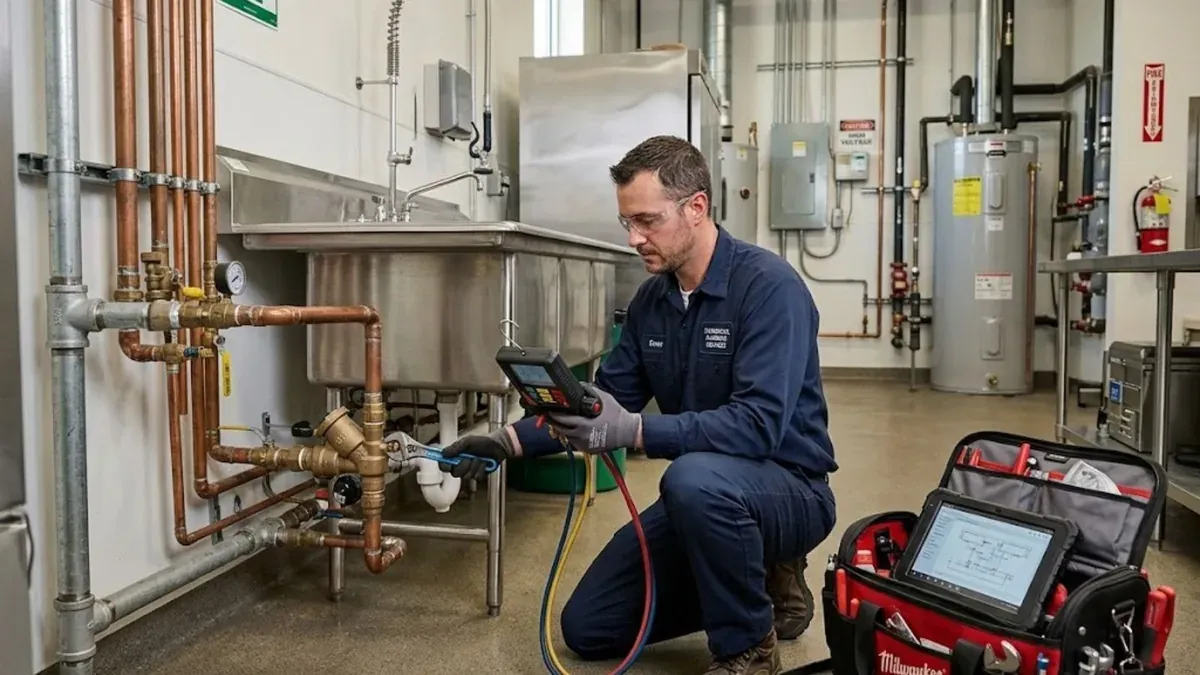
Commercial plumbing in Chino, CA covers businesses that rely on working water and drains: restaurants, retail shops, offices, warehouses, medical suites and multi-unit buildings. Problems tend to be larger and more urgent than a house call, since a failed line can close a business and affect neighbors in a shared building.
This page covers emergency repairs, scheduled maintenance, grease management and testing.
After-hours plumbing emergencies at a business
A burst pipe in a suite, a backed-up restroom or a floor drain overflow in a kitchen is an emergency. Before the plumber arrives, take these steps.
- Find and close the shutoff for the affected area or the building main. Tenants should know where it is.
- Close the business to customers in wet or sewage-affected areas.
- Notify the property manager or landlord, since shared lines may be their responsibility.
- Protect inventory, electronics and records. Move them off the floor.
- Document the damage for the insurer and note when the problem began.
Restaurants and food service
Kitchens put grease, food solids and heavy water use into lines every day. Grease traps and interceptors catch most of it, and they need regular pumping. The City of Chino Building Division publishes grease interceptor and sand interceptor standards, so ask the division at (909) 334-3251 about requirements for a new or renovated kitchen. Routine hydro jetting keeps lines clear between pump-outs.
Retail, office and warehouse buildings
Restroom fixtures, water heaters, floor drains and roof drains are the main systems. Chino has a mix of retail centers, including Chino Spectrum Towne Center and the Country Fair Shopping Center on Central Avenue, and industrial and warehouse space in the surrounding area. A leak in one suite can travel to others, so quick isolation and clear communication with the property manager matter.
Backflow testing and prevention
Many commercial properties have backflow preventers that protect the public water supply. They need periodic testing by a certified tester, and local water providers set the schedule. Ask your water provider for its backflow program requirements, since they vary.
| Problem | Typical cause | First move |
|---|---|---|
| Restroom backup | Main line blockage | Close the restroom and call us |
| Kitchen floor drain overflow | Grease or trap full | Stop dish machine use |
| Water at ceiling | Pipe or fixture above | Close the shutoff for that area |
| No hot water | Heater failure | Check breaker or gas supply |
| Parking lot pooling | Clogged storm drain | Clear surface debris |
Business plumbing emergency?
Call now.
Storm drains and exterior lines
Parking lots and loading areas have storm drains that clog with leaves, trash and sediment. Cleaning them before the rainy season prevents flooding on the lot. This work is separate from sanitary sewer cleaning.
Landlords, tenants and property managers
The question of who pays often decides how fast a repair starts. Tenants should check the lease, and landlords should know which lines are theirs. A plumber can document the cause and location, which helps sort out responsibility. Our leak detection page covers hidden leaks in commercial buildings.
What commercial plumbing prices depend on
What moves the price
Commercial jobs vary widely, so these factors apply.
Commercial plumbing questions
Yes.
Yes, though who pays depends on the lease.
Ask about size and schedule when you call.
Yes. Give the address and an on-site contact for access.
Yes. See the Chino Hills page.
Regular maintenance prevents most emergency calls. Annual drain cleaning with sewer line cleaning and periodic checks of water heaters and shutoff valves make failures rarer.
Commercial work follows the California Plumbing Code (based on the Uniform Plumbing Code, UPC) and the permit rules of the local Building Division.