
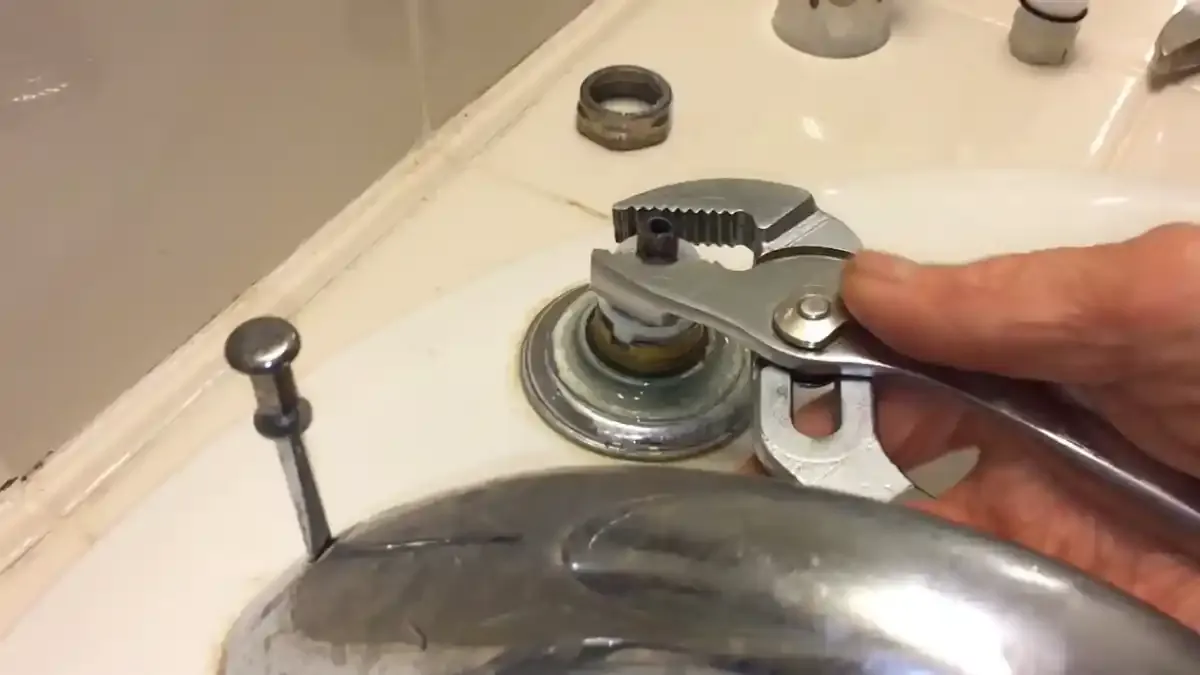
A leaking faucet handle is more than a nuisance. Water seeping from under the handle can run down into the cabinet, swell the base of the vanity and stain a countertop. The drip is usually small, which is why it often goes ignored until the cabinet floor is soft.
The repair is straightforward once you know which kind of faucet you have. Most home faucets fall into four types: compression, cartridge, ball and ceramic disc. Each leaks for a different reason and uses a different part.
Identify your faucet type
A compression faucet has two separate handles that you turn several times to close. A cartridge faucet may have one or two handles and a smooth feel. A ball faucet has a single handle on a rounded cap, common in kitchens. A ceramic disc faucet has a single lever that rotates on a wide cylinder.
If you cannot tell, remove the handle and look inside. Compression faucets show a stem with a rubber washer. Cartridge faucets show a brass or plastic cylinder. Ball faucets show a metal ball with slots. Disc faucets show a flat ceramic cartridge.
Prepare the repair
Close the shutoff valves under the sink by turning them clockwise, then open the faucet to drain it. Plug the sink drain so small parts do not fall in. Take a photo of the faucet before you start, and lay the parts out in order as you remove them.
Have a screwdriver, an adjustable wrench, an Allen key set, a small pick, plumber's grease and the replacement parts ready. Parts are specific to the brand and model, so bring the old ones to a supply store if you cannot identify them.
Compression and cartridge faucets
Pry off the cap on the handle, remove the screw and lift the handle off. For compression faucets, unscrew the packing nut and the stem, then replace the O-ring on the stem and the seat washer at the end. For cartridge faucets, remove the retaining clip or nut and pull the cartridge straight out, using the specific puller if it is stuck.
Install the new cartridge in the same orientation, because many are keyed so hot and cold are not reversed. Grease the O-rings lightly, reassemble and turn the water on slowly.
| Faucet type | How to spot it | Usual leak part |
|---|---|---|
| Compression | Two handles, many turns to close | Stem washer and O-ring |
| Cartridge | One or two handles, smooth feel | Cartridge or its O-rings |
| Ball | Single handle on a rounded cap | Seals, springs and cam |
| Ceramic disc | Single lever on a wide cylinder | Cartridge seals |
Stuck on this job?
Call and tell us about your plumbing issue.
Ball and disc faucets
A ball faucet usually leaks at the base of the handle because of worn seals and springs, and a repair kit has all the replacement parts. Tighten the adjusting ring with the small wrench included in the kit before you replace anything. A ceramic disc faucet leaks when the seals under the cartridge fail, and a new cartridge is the usual fix.
When to replace the faucet or call a plumber
If the faucet is decades old, heavily corroded or discontinued, parts may be impossible to find. A new faucet often makes more sense than hunting for old parts, and it brings better flow control. If the shutoff valves will not close, or if they leak when you turn them, call a plumber, because forcing them can create a bigger leak. See our faucet repair page for a visit, and our plumbing installation page for new fixtures.
A small mistake to avoid
Do not overtighten the handle screw or the retaining nut once the new part is in. Forcing a cartridge into place or cranking a nut can crack plastic housings and strip brass threads, and then you are shopping for a new faucet anyway. Snug is enough. Test by running the faucet through hot, cold and mixed positions with the water on, and watch the base for seepage.
Faucets and water in Chino homes
Hard water leaves mineral crust around faucet bases and inside cartridges, and that crust wears seals faster. Chino Hills publishes its water report at chinohills.org/CCR, and the city's Water Quality Technician can be reached at (909) 364-2808. A report review tells you what is in your water before you decide on a filter or softener.
Many Chino homes date from the tract-building decades after the 1970s, so faucets and shutoff valves may be original. If the shutoff valves under your sink are stuck or leaking, replacing them at the same time is wise. Our page on emergency plumber Chino Hills covers the same service for the west side.
Questions about this job
A worn O-ring or seal at the stem or cartridge is the usual cause. Water takes the easiest path and seeps up around the handle.
Not unless parts are discontinued or the faucet is badly corroded. A cartridge or seal kit often restores it.
Match the brand and model number. If it is missing, take the old cartridge to a supply store.
Do not force them. Call a plumber, who can replace them safely.