
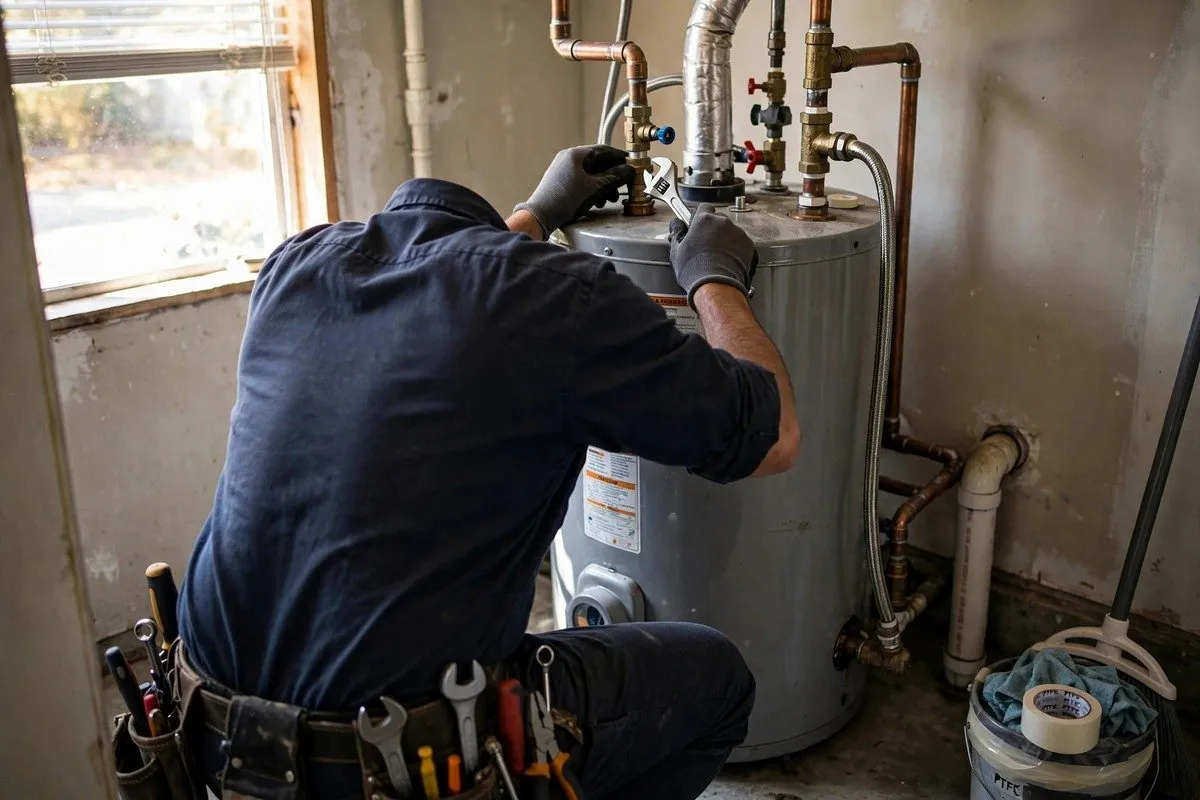
If your gas water heater runs fine until you let go of the pilot button, then goes dark a minute later, the thermocouple is the usual suspect. It is a small copper-tipped probe that sits in the pilot flame and generates a few millivolts of electricity. That tiny current holds open the gas valve. When the probe wears out, the valve closes, the pilot dies and the tank stops heating.
The part is cheap, and replacing it is a job many homeowners with basic tools can manage. It is also a gas appliance, so this guide spends as much time on when to stop as on how to do it. If you smell gas at any point, leave the house and call the gas utility or 911 before you call anyone else.
Confirm the thermocouple is the problem
Before you buy anything, rule out the simpler causes. A pilot that will not light at all may be a blocked pilot tube or an empty gas supply. A pilot that lights and stays lit while you hold the button, then dies when you release it, points to the thermocouple or to the gas control valve it feeds. A sooty or yellow, lazy flame suggests dirt at the pilot orifice, and cleaning that may be all you need.
Look at the probe itself. The flame should wrap the tip of the thermocouple. If the tip is bent away from the flame, black with soot or visibly pitted, it cannot produce enough current. If everything looks fine and the pilot still drops out, the gas control valve may be failing, and that is a plumber's job.
Tools and parts
You need a replacement thermocouple that matches your heater, an adjustable wrench or a 7/16 inch open-end wrench, a flashlight and a small piece of fine sandpaper. Match the length and the connector style to the old part. Taking the old one to a supply counter, or reading the model number on the heater's data plate, saves a second trip.
Some newer heaters do not have a thermocouple at all. They use electronic ignition and a flame sensor, and the repair is different. If your heater has no standing pilot, stop here and check the manual.
Step by step
Set the gas control to OFF and wait at least five minutes so that any gas near the burner clears. Close the gas supply valve on the line to the heater if you can reach it. Remove the burner access cover. On most tanks it slides or pulls off without tools.
Follow the thin copper line from the pilot assembly back to the gas control valve. Unscrew the nut that holds it at the valve, then free the probe from the pilot bracket. Slide the new thermocouple into the same bracket so the tip sits in the flame path, and thread the nut finger tight at the valve. A quarter turn with the wrench is enough. Overtightening crushes the fitting.
Reopen the gas valve, set the control to PILOT, press and hold the button and light the pilot using the igniter or a long lighter. Keep holding for about a minute, release, and watch that the pilot stays lit. Then turn the control to ON and confirm the main burner ignites.
| What happens | Likely cause | Next step |
|---|---|---|
| Pilot lights, then dies when you release the button | Worn thermocouple | Replace the thermocouple |
| Pilot will not light at all | Blocked pilot tube or no gas | Clean the pilot tube, check the gas valve |
| Pilot stays lit but burner will not fire | Gas control valve or thermostat fault | Call a plumber |
| Yellow, floppy pilot flame | Dirt at the pilot orifice or poor combustion air | Clean and check the draft |
| Smell of gas | Leak or unlit gas escaping | Leave and call the gas utility or 911 |
Stuck on this job?
Call and tell us about your plumbing issue.
Test for gas leaks afterward
Brush a little soapy water on the fitting you disturbed. Bubbles mean a leak, and the nut needs a gentle snug or the fitting needs to be remade. If you smell gas rather than just see bubbles, close the supply valve and leave. Do not look for the leak with a flame.
Check the draft as well. The vent should pull the burner exhaust up and out. If a match flame near the draft hood leans away from the vent, or you see soot around the top of the heater, call a plumber before using the heater again.
When to call a plumber instead
Call for help when the new thermocouple does not cure the problem, when the heater is rusty at the base or leaking, or when you are not comfortable working near a gas line. A heater past roughly a decade of service is often better replaced than repaired, because the tank may fail soon after. Our water heater repair page explains what a visit covers, and the water heater replacement page covers the next step if the tank has reached the end.
Safety rules for any gas appliance repair
Never work on a gas appliance in a closed space with a smell of gas, and never use a flame to test a connection. Keep children and pets out of the garage while the burner is open. If the heater sits near paint, gasoline or other flammable vapors, move those items out before you relight the pilot.
Gas water heaters in Chino homes
Chino grew from a farming and dairy town that was first subdivided in 1887, so the housing stock runs from older homes near downtown to tracts built since the 1970s. Many garage water heaters in those homes are gas units, and the original ones are long retired. Replacements installed after 2008 and 2010 are the ones now reaching the age where small controls start to fail.
Permits for water heater work are handled by the City of Chino Building Division at 13220 Central Avenue, Chino, CA 91710, phone (909) 334-3251. Ask whether a like-for-like part swap needs anything, and confirm before a full replacement. If you live west of the city line, our page on emergency plumber Chino Hills covers the same service.
Gas appliance connections are covered by the California Plumbing Code, which is based on the Uniform Plumbing Code (UPC).
Questions about this job
Many last several years, and a few fail within a few. Corrosion, soot and a pilot flame that drifts away from the tip all shorten the life. A heater that keeps losing its pilot after a new thermocouple needs a look at the gas control valve.
They are different parts. A thermocouple holds a gas valve open on a standing pilot. A thermopile makes more power and is used on some valves and fireplaces. Use the part your heater's manufacturer lists.
Many homeowners do it by following the label on the heater. Stop if you smell gas, if the flame will not stay lit or if the heater has any water leaking around it.
Then it likely uses electronic ignition and a flame sensor. The repair differs, and the manual or a plumber should guide you.