
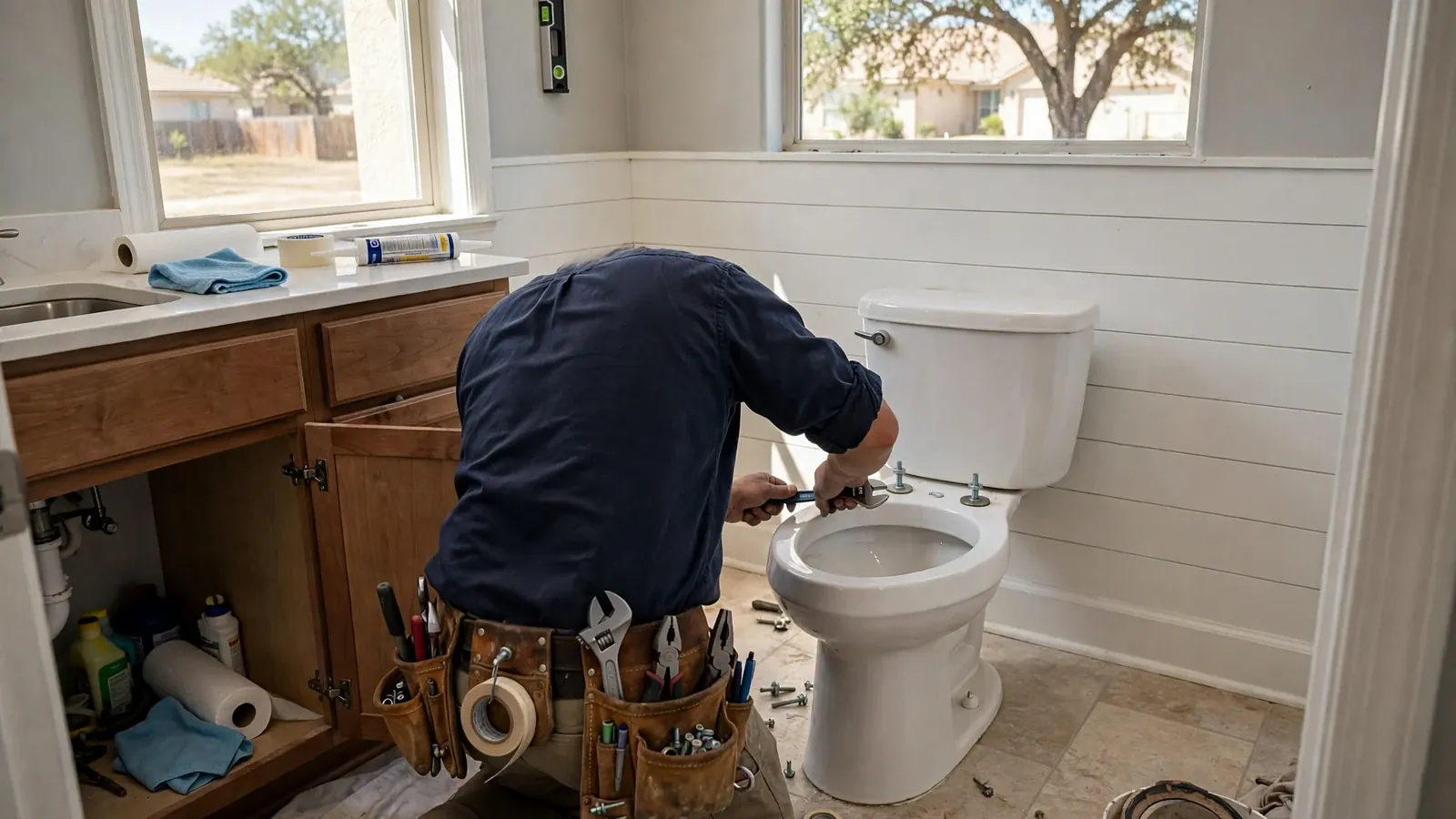
Toilet repair in Chino, CA covers the problems that make a bathroom unusable and the quieter ones that waste water for months. Overflow, constant running, a weak flush, a leak at the base, a rocking bowl, and a tank that sweats all have different causes and different fixes. Most are quick repairs when caught early.
Beyond repair, plumbers also install new toilets, replace flanges and wax rings, and fit new fill valves and flappers. A modern toilet rated at 1.28 gallons per flush uses a fraction of the water of old 3.5 gallon models.
When a toilet problem is an emergency
An overflowing toilet, a leak spreading from the base or a supply line spraying water is an emergency. Take these steps right away.
- Lift the tank lid and push the flapper down to stop water entering the bowl, or close the float.
- Turn the shutoff valve behind or beside the toilet clockwise until the water stops.
- Do not flush again, even if the bowl seems to drain.
- Put towels around the base and lift rugs away from the area.
- If water is coming through the ceiling below, close the main valve and call us.
The toilet that runs
A running toilet is almost always a worn flapper or a stuck fill valve. The flapper is the rubber seal at the bottom of the tank, and mineral deposits and age stop it from sealing. The fill valve controls refilling and can fail to shut off. A dye test, a few drops of food coloring in the tank, shows a flapper leak within 15 minutes. These parts are inexpensive and swapped in minutes.
Clogs and overflows
A plunger with a flange cup handles most clogs. If the toilet stays full or the clog returns, a closet auger reaches deeper, and a persistent clog may point to the drain beyond the toilet. Our clogged toilet guide walks through the steps. If other fixtures are also slow, the main line may be involved, which is covered on drain cleaning.
Leaks at the base and rocking bowls
Water around the base usually means a failing wax ring or a loose closet bolt, and a rocking toilet adds movement that breaks the seal. A rotten floor can result if the leak goes on for months. The fix is to pull the toilet, inspect the flange, replace the wax ring or a flange repair ring, and reset the toilet level.
| Symptom | Likely cause | Typical fix |
|---|---|---|
| Runs all the time | Worn flapper or fill valve | Replace the part |
| Weak flush | Clogged rim jets or low water level | Clean jets, adjust level |
| Water at the base | Failed wax ring or loose bolts | Reset the toilet with a new ring |
| Rocks side to side | Loose bolts or bad flange | Tighten or repair the flange |
| Keeps clogging | Drain restriction beyond the trap | Auger and inspect the line |
Toilet overflowing?
Flush valve and tank parts
The flush valve connects the tank to the bowl and the flapper seals on it. If it is cracked or the seat is pitted, the toilet runs even with a new flapper. Replacing the valve is a DIY job on many models, as our flush valve guide describes, though a leaking tank bolt or a hidden fault is worth a plumber.
New toilet installation
A replacement or upgrade involves removing the old toilet, checking the flange height and condition, setting a new wax ring, tightening bolts evenly, and testing for leaks and flush performance. Rough-in distance, the gap from wall to flange center, decides which models fit. See plumbing installation for related work.
What toilet repair pricing depends on
What moves the price
Toilet repair FAQ
Yes.
Lift the tank lid and close the flapper, then turn the shutoff valve clockwise. Do not flush again.
A worn flapper or fill valve is the usual cause. A dye test confirms a flapper leak.
Many homeowners can, but flange problems and leaks are common surprises. A plumber is wise if the floor is soft.
Yes. See the Chino Hills page.
If water is also leaking from a nearby sink, check the faucet repair page. For repeat clogs involving several fixtures, the problem may be in the line behind them.
Replacement toilets sold in California must meet state water efficiency limits, which is why newer fixtures use less water per flush.