
Water filters are sold with a lot of promises, and most of them are narrow. A sediment filter catches sand and rust flakes. A carbon filter reduces chlorine taste and odor. A reverse osmosis system removes dissolved minerals and many contaminants at one tap. A softener swaps hardness minerals for sodium or potassium. None of them does everything.
The right system starts with a goal. Do you want better taste, scale protection for a water heater, or removal of something a lab test found? Once you know, building a basic filtration setup is within reach of a careful DIYer, and a plumber can handle the main line connection.
Read your water report first
Public water systems publish an annual Consumer Confidence Report that lists what is in the water at the point it enters the distribution system. It tells you the source, contaminant levels measured and any violations. Your report will not show what your own pipes add, so a tap test is useful if you have old plumbing.
If you use a well, there is no such report. A lab test from a certified laboratory is the starting point for any filter choice.
Choose the stage
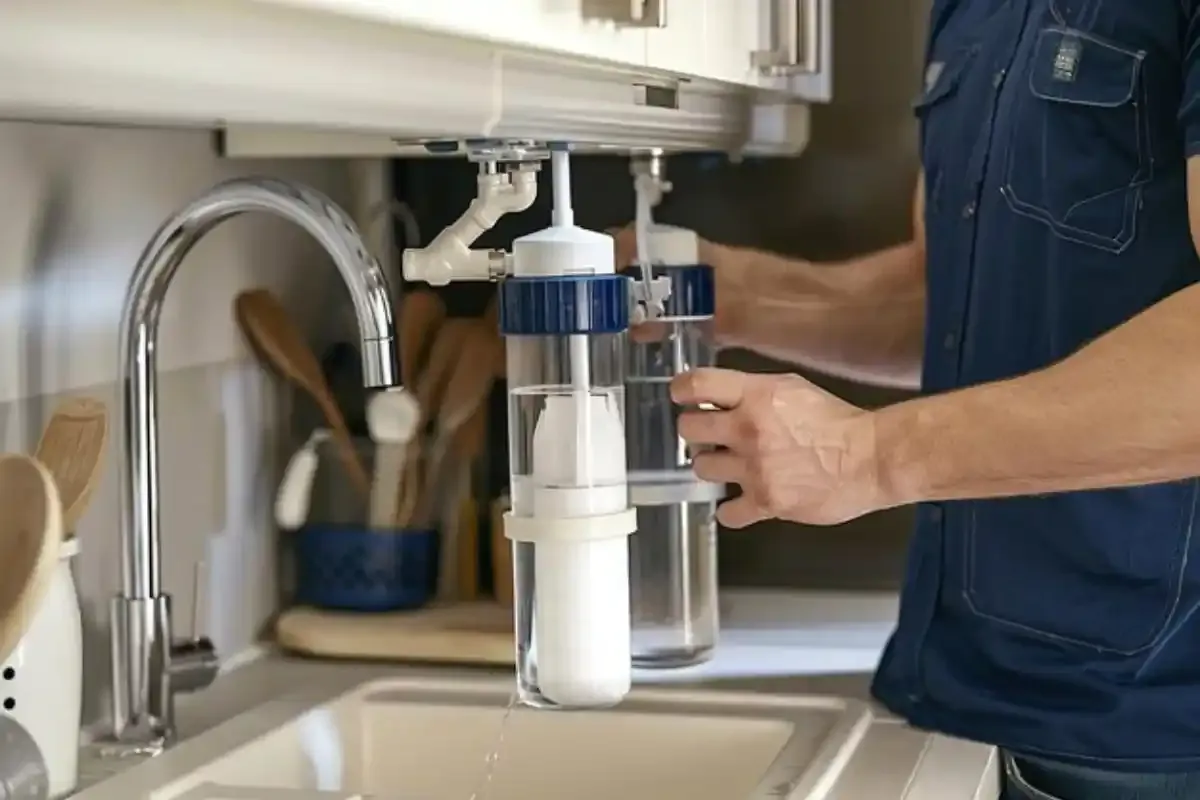
A basic whole-house setup runs water through a sediment filter, then a carbon block, and optionally a softener or scale control device. Each stage sits in a housing with a bypass valve and pressure gauges before and after, so you can see when a cartridge is clogged.
Under-sink reverse osmosis serves drinking and cooking water at one faucet, with a small tank and a dedicated tap. It does not replace a whole-house system, and it uses extra water to flush the membrane.
Install it
Shut off the main water valve and open a tap to relieve pressure. Find a spot downstream of the main shutoff and the pressure regulator, with room to remove the filter housings and a floor drain nearby. Cut the pipe, install a bypass valve set and mount the housings in order of sediment first, carbon second.
Use compression, push-fit or sweat connections that match your pipe, and support the housings with brackets, because a full housing is heavy. Open the supply slowly, run a tap to clear air and check each joint.
| Stage | What it handles | What it does not do |
|---|---|---|
| Sediment filter | Sand, rust flakes and silt | Dissolved chemicals |
| Carbon block | Chlorine taste and odor, some organic compounds | Hardness minerals |
| Reverse osmosis | Many dissolved solids at one tap | Whole-house flow |
| Water softener | Hardness scale | Chlorine or contaminants |
Stuck on this job?
Call and tell us about your plumbing issue.
Maintain it
Cartridges clog over time. A drop in pressure after the filter is the signal to change one. Mark the install date on the housing and follow the manufacturer's replacement interval. Leaving a spent cartridge in place can pass trapped material and grow bacteria in the housing.
Sanitize the housing when you change a cartridge, and replace the housing O-rings with a lubricant approved for drinking water.
When to involve a plumber
Tie-ins to the main line, systems that need a drain for backwash and any softener connect to the building plumbing, and they require a permit in some places. See our water softener and filtration page for installation, and our plumbing installation page for new lines.
Common mistakes to avoid
The most common mistake is buying the largest system without knowing what needs removing. The second is placing the filter before the pressure regulator, where full street pressure can burst a housing. The third is forgetting to leave room under the housings to unscrew them, since a full housing needs a clear drop of several inches.
A fourth is ignoring the flow rate. A filter rated for too little flow chokes a house with several fixtures running. Match the rating to your pipe size and peak demand, and install pressure gauges so you can see the drop.
What Chino Hills water reports say
The City of Chino Hills supplies its own drinking water. Its Consumer Confidence Report says the water comes from groundwater wells, including City-owned wells, Monte Vista Water District wells and Chino Basin Desalter Authority wells, plus imported State Water Project water. The Water Quality Technician answers report questions at (909) 364-2808, and the report is posted at chinohills.org/CCR.
Chino residents should ask their own water provider for its report. We do not quote a hardness number here, because the report is the right source. See our page for Chino Hills plumbing for service coverage.
Look for filters certified to NSF/ANSI 42 or 53, and install them to the California Plumbing Code, which is based on the Uniform Plumbing Code (UPC).
Questions about this job
City treatment makes water safe to drink. A filter can improve taste, remove sediment and protect appliances, but it depends on your goals.
Follow the manufacturer's interval, and replace sooner if pressure drops.
No. Softening needs an ion exchange softener or a scale control device.
A state certified lab can test a sample. Your water provider can also say what its report covers.