
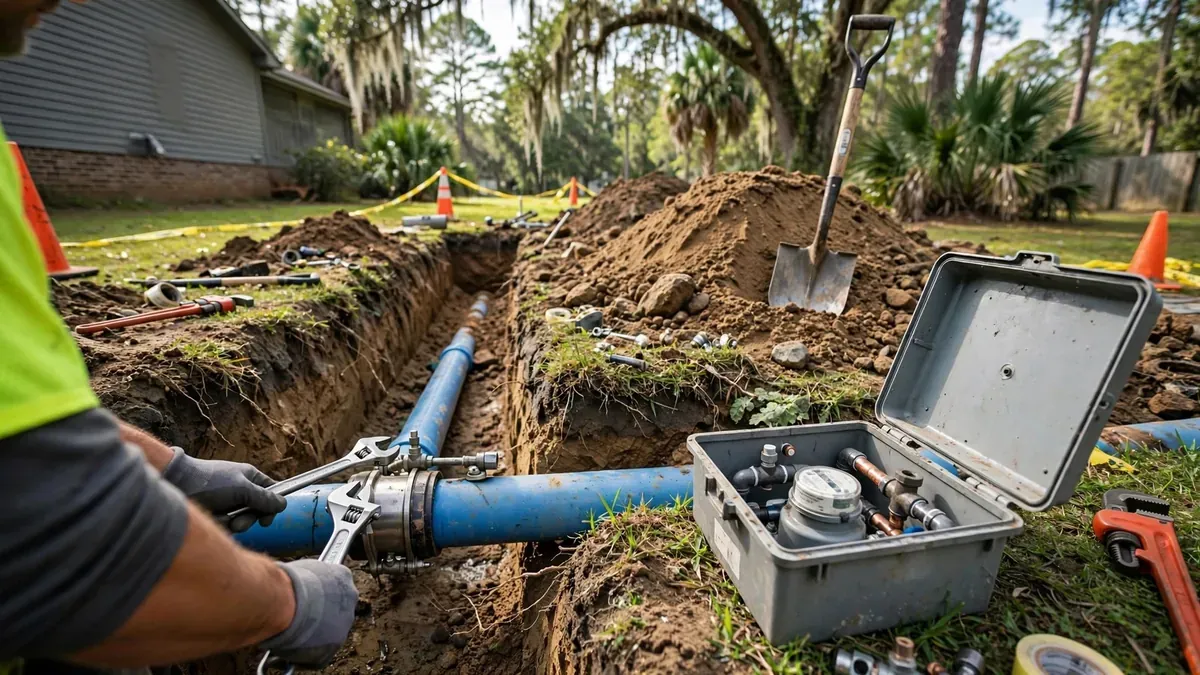
Water line repair in Chino, CA covers the service line that runs from the meter to your house. When it cracks, corrodes or is hit by a shovel or a root, water escapes underground. Signs include a meter that runs after you close the main valve at the house, a wet or sunken patch in the yard, lowered pressure and an unexplained rise in your bill.
The service line is usually your responsibility from the meter to the house, though who owns which part varies by water provider. A plumber can repair a short section or replace the whole line, and the choice depends on pipe age and material.
When a service line leak is an emergency
Water surfacing in the yard, flooding near the foundation or a total loss of water pressure is an emergency. While you wait for the plumber, do the following.
- Close the main shutoff valve at the house. If the leak continues, the break is on the street side of that valve.
- Locate the meter and its shutoff. Many meters have a valve on the utility side that only the utility should operate.
- Call your water provider if the leak is at or before the meter. They own that part.
- Keep people and pets away from soft or sinking ground.
- Note the meter reading and take photos of wet ground before any digging.
Is the leak on your side of the meter?
The meter is the dividing line in most cases. Water provider responsibility ends at the meter, and yours begins after it, though some providers differ. Call your water provider if you are unsure where your line starts. Our leak detection page describes how to run the meter test.
Low water pressure
Low pressure can come from a leak, a partly closed valve, a failing pressure regulator, corroded pipe or a problem at the street. Test pressure with a gauge on a hose bib. Anything below about 40 psi feels weak, and anything above about 80 psi strains fixtures. If pressure drops only in the house, the problem is inside. If it drops everywhere, the service line or regulator is suspect.
Repair, replace or trenchless?
A localized leak in sound pipe is a spot repair, which means digging to the break and replacing a section. A line that has leaked more than once or is made of old galvanized steel is a replacement candidate. Trenchless methods like pipe bursting pull a new line through the old path with fewer trenches. A plumber evaluates your yard and driveways.
| Symptom | Suggests | Next step |
|---|---|---|
| Meter runs, house valve closed | Leak between meter and house | Call us |
| Wet patch in the yard | Leak at the line or irrigation | Isolate irrigation, test the meter |
| Pressure drops everywhere | Regulator or service line | Gauge test |
| Brown water | Corroded line or street work | Run cold taps, call if it continues |
| No water at all | Main valve, break or street issue | Check with neighbors and provider |
Water line leak?
Permits and utility coordination
Digging requires calling 811 before you start so buried utilities are marked. Work on a water service line may also need a permit and inspection, so ask the City of Chino Building Division at (909) 334-3251 how it applies to your address.
Irrigation tie-ins
Landscaping systems tap the service line, and a leaking valve or a broken sprinkler can mimic a main line leak. Isolate irrigation first. If the meter keeps running with it off, the problem is in the line.
What a service line repair costs depend on
What moves the price
Water line questions
Yes.
Typically the owner from the meter to the house. Confirm with your provider.
A meter test narrows it. A plumber then uses listening and locating tools.
Only where necessary. Trenchless options reduce digging.
Yes. See the Chino Hills page.
A service line is a long-term asset. If yours is old galvanized steel, replacing it avoids repeated digging. Related options: slab leak repair for lines under the foundation and burst pipe repair inside the house.
Main water line replacement uses pipe and fittings rated for potable water, and the permit inspection checks depth and bedding.