
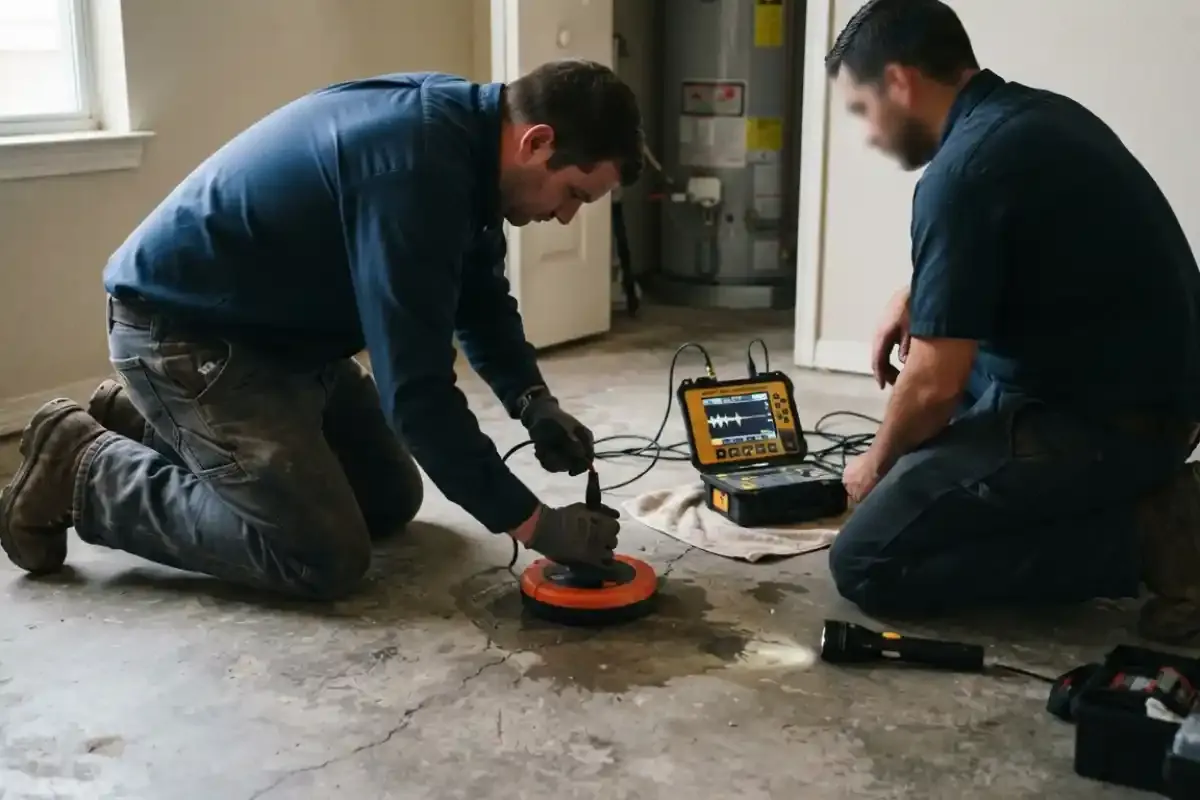
Many homes in the Inland Empire are built on concrete slabs, with water lines and drains running through or under the concrete. A leak there is hard to find and expensive to ignore. Water can undermine soil, lift flooring and run the water bill up long before a stain appears.
Slab leaks are often in the hot water line, which sits under heat and flexing every time the heater cycles. Copper pipe can also corrode from the outside if soil conditions are aggressive. Whatever the cause, the response is the same: confirm it, locate it and pick a repair that fits the condition of the rest of the plumbing.
Signs of a slab leak
A warm spot on the floor, the sound of running water when everything is off, a water meter that moves with all fixtures closed, a sudden jump in the bill, damp carpet, cracked tile and low hot water pressure all point that way. A musty smell at the baseboard also counts.
Check the meter. Turn off every fixture, then look at the leak indicator on the meter. If it keeps moving, water is escaping somewhere. Our leak detection page explains how a plumber narrows it down.
How the leak is located
A plumber uses electronic listening equipment that picks up the sound of escaping water, thermal imaging that shows a warm line under the floor and pressure tests that isolate which line is leaking. The goal is to find the leak within a small area so the repair breaks as little concrete as possible.
Option 1: spot repair through the slab
The plumber saws and breaks out a small section of concrete above the leak, repairs or replaces the damaged pipe and patches the slab. It is the least expensive choice and suits an isolated leak in an otherwise healthy line. Floors above may need patching to match.
The weakness is that other spots can fail next. If the line is old, you may be back in the same situation within a few years.
| Option | Best for | Tradeoff |
|---|---|---|
| Spot repair | Single leak, healthy line | Concrete patch, other spots may fail |
| Reroute through attic or walls | Repeat leaks on one line | Opens walls and ceilings |
| Repipe the house | Multiple leaks or failing pipe type | Highest cost, most disruption |
| Epoxy lining | Some pipe conditions | Not suited to all lines, check the code |
Stuck on this job?
Call and tell us about your plumbing issue.
Option 2: reroute the line
Rerouting abandons the leaking line under the slab and runs new pipe through the attic or walls to the fixtures. It avoids concrete work and gives easy access in future, but it opens walls and ceilings and changes the look of the home. It suits a line that leaks more than once.
Option 3: repipe the house
If several leaks have appeared or the pipe is a type known to fail, repiping the whole house may be more sensible than repairing each leak. See our repiping page and slab leak repair page for how these jobs are handled.
What to do the day you suspect a leak
Shut off the water at the main valve if the leak seems active, and check the meter again after an hour. If the meter has stopped, the leak is somewhere in the house. If it keeps moving with the main closed, the leak is on the street side of the shutoff. Take photos of any damp flooring and the meter reading, and call a plumber.
Do not tear up flooring yourself. A leak detection visit usually pinpoints the spot and keeps the damage small.
Insurance and documentation
Keep the leak detection report, photos of the damage and every invoice. Your insurer may ask for them. Many policies exclude the cost of repairing the pipe itself but cover water damage to the home that results, so review your policy before work begins. Ask your plumber to write down the cause and the location in plain words.
Slab homes in Chino and Chino Hills
Chino Hills grew rapidly in the 1980s and early 1990s, and many neighborhoods built in that window are slab-on-grade homes now 30 to 40 years old. Original copper and some polybutylene lines from that period are reaching the age when leaks appear. If you see gray or blue plastic pipe at the water heater, tell your plumber.
Slab repairs and repipes normally need a permit. The City of Chino Building Division at 13220 Central Avenue, Chino, CA 91710 and (909) 334-3251 can say what applies. Our page on emergency plumber Chino Hills lists coverage.
Repairs are checked against the California Plumbing Code, which is based on the Uniform Plumbing Code (UPC).
Questions about this job
Warm floor spots, the sound of running water with everything off, a moving meter and a higher bill are the classic signs.
It depends on the policy. Many cover resulting damage but not the pipe itself. Ask your insurer.
A long running leak can erode soil under the slab. Early repair limits the risk.
A spot repair can be a day or two. A reroute or repipe takes longer.